Leather belts are a staple accessory in the global fashion market, occupying a large share of business demand. The cowhide leather belt material used directly decides a product's cost structure, pricing strategy, target customers and long-term brand reputation. For B2B buyers, being able to know the difference between top grain leather and split leather, and understanding their commercial value gaps, is the foundation of making smart purchasing and sales decisions.
This guide offers a full, objective comparison for B2B buyers. It covers belt material structure, production processes, physical performance, cost composition, market positioning and supply chain risks, helping you make accurate business judgments.
1. Structure vs. Process: The Quality Divide
The biggest difference between top grain leather and split leather lies in the leather layer selected and the production techniques applied. This fundamental gap creates huge differences in their physical properties and market value ceiling.
1.1 Top Grain Leather (Full Grain / Top Grain Leather)
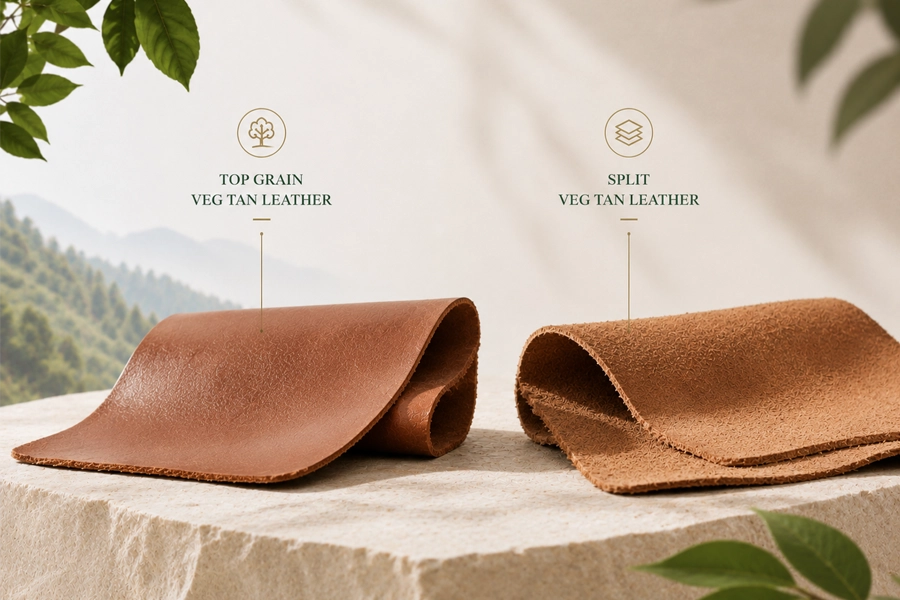
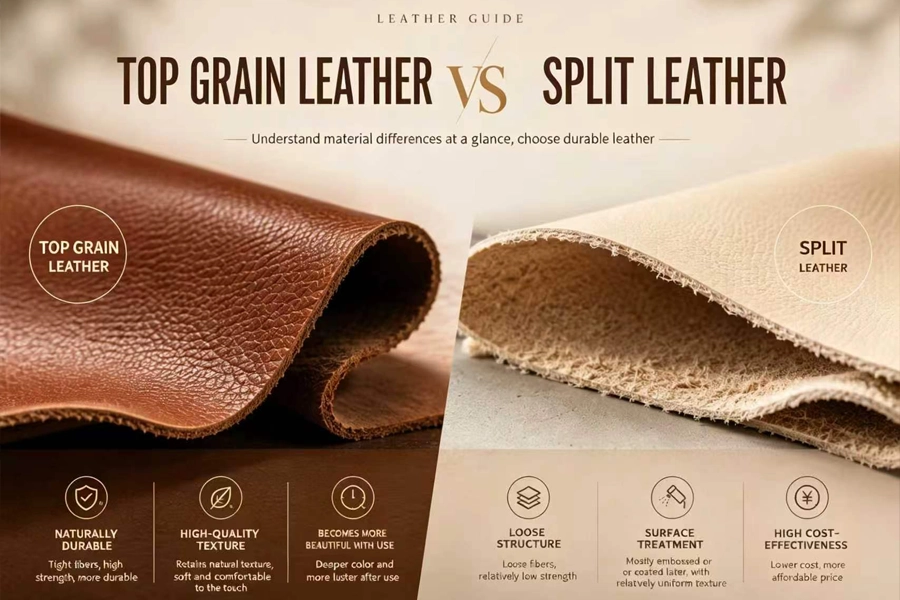
Top grain leather is the outermost layer of cowhide. It retains the natural grain layer and the densest fibrous layer of cowhide, which is the highest-quality part of cowhide materials.
Full Grain Leather: It represents the highest grade of top grain leather. No surface polishing or modification is done, so it fully preserves the natural grain, pores and subtle texture marks of cowhide. A unique advantage of this leather is that it develops a smooth, rich patina over time by absorbing human body oil. It truly gets better and more textured with use.
Top Grain Leather: This is the most widely used top grain leather in the mid-to-high-end belt market. To fix minor surface flaws and blemishes, the original grain layer is lightly polished, then pressed with standard natural leather textures. Though part of its natural features are lost, it still keeps the tough, sturdy fibrous structure of top grain leather, making it the mainstream material for mid-range and high-end leather belts.
Production Process: It mainly goes through tanning, dyeing and finishing procedures. The whole process is designed to maximally retain the natural structure and original performance of cowhide.
1.2 Split Leather (Split / Genuine Leather)
Split leather is the remaining fibrous layer after the top grain layer is peeled off from raw cowhide. It has no natural grain layer on its own, with a rough surface that cannot be used directly for finished products.
PU Coated Split Leather: This is the most common split leather on the market. A layer of polyurethane (PU) film is coated on the rough split leather surface, then pressed with simulated leather textures to achieve a finished look.
Microfiber Composite Split Leather: It is made by compounding microfiber materials on standard split leather to improve softness and durability. Even with upgraded hand feel and strength, it still belongs to the split leather category in essence.
Production Process: The core steps are film coating and texture transferring. The base split leather has low inherent value, so the final product quality largely depends on the quality of the outer PU film.
1.3 Industry Terminology Clarification
According to China's leather industry standards, both top grain leather and split leather are defined as "genuine leather". This is a common misleading point for buyers and end consumers. The "genuine leather" label does not equal high quality. Many suppliers mark split leather products as genuine leather to raise their perceived value.
2. Performance vs. Profit: The Leather Divide
A leather belt's physical performance directly determines user experience, service life and after-sales costs. The table below compares the key performance indicators of the two materials and their practical business impacts.
| Comparison Dimension | Top Grain Leather Belt | Split Leather Belt | Analysis |
|---|---|---|---|
| Durability | Ultra-durable Dense natural fibers Lasts 5–10+ years | Moderately durable Loose fibers + PU film Lasts 1–3 years | Top-grain: Low repairs, strong reputation. Split leather: High quality risks, costly complaints. |
| Wear Resistance | Highly wear-resistant Smoother with age Stable quality | Poor wear-resistance Prone to peeling & surface damage | Split leather peeling triggers major negative reviews and destroys brand trust. |
| Breathability | Highly breathable Prevents sweat Premium comfort | Non-breathable Sealed PU film Stuffy & uncomfortable | Breathability is the definitive standard separating high-end products from budget ones. |
| Flexibility | Highly flexible Crease-resistant Quick recovery | Rigid & stiff Low elasticity Prone to PU cracking | Superior fit and comfort make top grain a mandatory choice for high-end lines. |
| Texture & Luster | Natural gloss Unique irregular grain Premium look & feel | Plastic texture Dull, repetitive pressed grain Low-end look | Texture drives product tiering; top grain is essential for premium brand pricing. |
| Eco-friendliness | Highly eco-friendly 100% biodegradable Natural protein | Low eco-friendliness Non-degradable PU layer Generates waste | Top grain leather is the ideal choice to fulfill sustainable branding and green market demands. |
3. Cost vs. Value: The Pricing Strategy
Cost control is the core of B2B purchasing decisions. Understanding the cost gap between the two leathers helps you formulate accurate pricing schemes and profit strategies.
3.1 Raw Material Costs
Top Grain Leather: Raw material cost is relatively high. Only 20% to 30% of a whole cowhide can be used as qualified top grain leather. Its price varies greatly based on cow breed, feeding conditions, origin and surface integrity. For example, imported Italian vegetable-tanned top grain leather costs 5 to 10 times more than ordinary split leather.
Split Leather: Raw material cost is very low. Multiple layers of usable split leather can be obtained from one cowhide after removing the top grain layer. Its raw material cost is only 1/3 to 1/5 of top grain leather.
3.2 Processing & Auxiliary Costs
Top Grain Leather: It requires sophisticated processing techniques, skilled workers and precision equipment to avoid damaging the natural leather surface. Matching accessories like high-grade alloy, brass or stainless steel buckles further increase the overall production cost.
Split Leather: The production process is simple with low requirements for worker skills. To control total costs, it is usually paired with low-cost iron or ordinary alloy buckles.
3.3 Terminal Pricing & Profit Margin
Top Grain Leather Belts
- Factory price: $4 - $9 (varies by leather grade and craftsmanship)
- Retail price: $25 - $60 for regular Amazon brands; $100 - $300 for light luxury international brands
- Profit feature: High gross profit margin and strong brand premium capability
Split Leather Belts
- Factory price: $3 - $6 (varies by surface treatment process)
- Retail price: Mainly $9.9 - $19.9 for mass consumer markets
- Profit feature: Relatively low gross profit margin, relying on high sales volume to gain profits with fierce market competition
4. Where to Win: Target Market Focus
Choosing between top grain leather and split leather is essentially choosing your target market and customer groups.
4.1 Core Market for Top Grain Leather Belts
- Mid-to-high-end business men's market: Core consumer group who prioritizes product quality, texture and brand image. They are willing to pay a premium for durable, comfortable and stylish accessories.
- Light luxury & designer brand market: Top grain leather is the fundamental material to build a high-end brand positioning.
- Gift & customized market: High-quality top grain leather belts are ideal choices for business gifts and employee benefits, with high practical and commemorative value.
- High-end cross-border e-commerce platforms: Amazon, eBay and other European and American platforms have consumers with high leather product awareness, who actively pay more for full grain leather products.
4.2 Core Market for Split Leather Belts
- Mass fast fashion market: Focuses on cost performance and fast style updates, meeting consumers' needs for frequent accessory replacement and trendy looks.
- Entry-level consumer market: Serves price-sensitive customers with low-cost alternatives that look like genuine leather.
- Promotion & gift market: Widely used as free gifts or bundled sales products due to ultra-low cost.
- Low-end wholesale & cross-border channels: Platforms like Temu, where ultra-low price is the core competitive advantage.
5. B2B Purchasing Strategies & Risk Tips
5.1 Product Selection Strategies Based on Brand & Sales Channels
Strategy 1: High-end Brands / Offline Sales
Recommendation: Adopt full grain leather or high-grade corrected top grain leather for all product lines.
Reason: Offline customers pay great attention to product touch and texture. Top grain leather is the only reliable choice to build high-end brand trust and image.
Strategy 2: Mid-range Brands / E-commerce Platforms
Recommendation: Take cost-effective corrected top grain leather as the main product line, and add a small number of full grain leather styles to upgrade brand positioning.
Reason: It balances quality, reputation and cost, ensuring competitive pricing in the mainstream market.
Strategy 3: Mass Brands / High-volume Sales Market
Recommendation: Use high-quality split leather for drainage and high-volume products.
Reason: Ultra-low price is the key to attract mass customers. Always choose suppliers with high-quality PU films to reduce after-sales risks.
5.2 Sourcing Safely: Avoiding Procurement Fraud
Many unregulated suppliers disguise split leather as top grain leather to gain excess profits, which is the biggest pain point in B2B leather purchasing. Here are 5 practical and reliable identification methods:
1. Check the leather cross-section (most accurate method): Ask suppliers for physical cross-section samples. Top grain leather has uniform color and dense fibers with clear natural pore layers. Split leather shows an obvious double-layer structure: a thin outer PU film and loose inner fibers.
2. Observe grain and pores: Top grain leather has irregular, natural textures and unevenly distributed real pores. Split leather has rigid, repeated pressed grain with no natural pores at all.
3. Bend test: Bending top grain leather creates soft natural folds that bounce back instantly. Bending split leather leaves permanent hard creases, and even tiny cracks on the PU film.
4. Burning test: Burn a small piece of leather scrap. Top grain leather burns with a natural hair-burning smell and turns into fine powder ash. Split leather gives off a pungent plastic odor and forms hard lumps after burning.
5. Contract constraint: Clearly state material standards (e.g., 100% top grain leather) in purchasing contracts, and specify liability and compensation for material fraud. Reserve the right of random inspection and require products to pass official material tests.
5.3 Supply Chain Quality Control Key Points
For top grain leather: Focus on leather grade, thickness consistency and color difference. Natural cowhide has inherent color and texture differences, so require suppliers to strictly sort and grade raw materials in batches.
For split leather: Focus on PU film adhesion and wear resistance. Low-quality PU films will peel off within months of use. You can conduct tape adhesion tests and friction wear tests to verify film quality.
6. Conclusion
There is no absolute "good" or "bad" between top grain leather and split leather. The core is matching the right material to your business positioning.
Top grain leather stands for high quality, durability and premium positioning. It brings higher brand premium, better market reputation and loyal customer groups, making it perfect for enterprises focused on long-term brand value and mid-to-high-end markets.
Split leather stands for cost performance, trendiness and high sales volume. It helps brands quickly occupy the mass market with low-price advantages, ideal for fast-fashion businesses targeting short-term sales growth and cash flow.
A professional B2B buyer does not blindly pursue the highest material grade. Instead, you need to balance cost, quality and profit based on your brand positioning, target customers, sales channels and business goals. This guide is for help you select suitable leather materials and reliable belt manufacturer, and gain competitive edges in the global leather goods market.
7.Frequently Asked Questions (FAQ)
7.1 Is full grain leather always better than corrected top grain?
It depends on your market.
Full grain is the highest quality and develops a beautiful patina over time, making it perfect for luxury and premium brands. However, corrected top grain has a more consistent appearance, fewer natural flaws, and lower cost. It is the best choice for mainstream mid-range markets where customers want reliable quality at an affordable price.
7.2 Are there any hidden costs I should watch out for?
Yes, common hidden costs include:
- Mold fees for custom buckles ($100-$800 per design)
- Custom packaging fees ($0.5-$1.5 per unit)
- Logo printing fees ($0.1-$0.5 per piece)
- Third-party material testing fees
Always ask for an all-inclusive quote upfront.
7.3 What should I do if I receive split leather belts that were supposed to be top grain?
This is why contract terms are critical. Your contract should clearly state:
- Exact material specification (e.g., "100% corrected top grain cowhide")
- Right to random third-party testing
- Penalty for material fraud (usually 2-3 times the order value) If fraud is confirmed, you can demand a full refund, replacement, or compensation.
7.4 Can I tell top grain from split leather without cutting or burning the belt?
Yes, three quick non-destructive tests work for most cases:
- Bend test: Top grain leather forms soft, natural wrinkles that disappear immediately when released. Split leather leaves hard, permanent creases and may show tiny cracks on the surface.
- Texture check: Top grain has irregular, unique patterns and visible pores. Split leather has perfectly uniform, repeated fake grain with no real pores.
- Edge inspection: Look at the belt's cut edge. Top grain has a consistent, dense fiber texture all the way through. Split leather shows a clear two-layer structure: a thin, smooth top layer (PU film) and a rough, fuzzy bottom layer.
7.5 How long will the PU film on split leather belts last?
It varies widely based on film quality.
Low-quality PU films start peeling within 3-6 months of regular use.
High-quality PU films (thickness ≥0.15mm with good adhesion) can last 1-2 years.
Always ask suppliers for PU film thickness specifications and conduct a simple tape adhesion test before placing bulk orders.
7.6 What is the standard production lead time?
Sample production: 7-10 days
Bulk order for split leather: 14-20 days
Bulk order for top grain leather: 15-25 days
Custom designs with new buckles: 25-35 days
Always add 3-5 days buffer for quality inspection and shipping arrangements.