Vegetable tanned leather belts are a top growing product in the global accessory market.
They stand out for eco-friendly features, natural texture and unique aging effects.
For B2B brands and distributors, these belts bring stable profits and good brand reputation.
This guide clarifies key differences between top grain and split veg tan leather belts.
We cover raw materials, craftsmanship, performance and commercial value here.
Our goal is to help you make smart and cost-effective sourcing decisions.
What Is Vegetable Tanned Leather?
Vegetable tanned leather is also called veg tan leather for short.
Manufacturers use natural plant tannins to process raw cowhide for this leather.
Common tannin sources include oak bark, mimosa and sumac plants.
It is one of the oldest and most eco-friendly leather making methods worldwide.
In contrast, mainstream chrome-tanned leather uses heavy metal chromium salts.
Tanning changes hide collagen structure to stop skins from rotting or shrinking.
Chrome tanning finishes fast, within 1 to 3 days, with uniform leather color.
Yet chrome leather contains heavy metals and cannot biodegrade naturally.
Veg tan tanning takes 30 to 90 days with slow tannin penetration into fibers.
It keeps natural leather pores and allows unique patina formation over time.
Core Market Advantages of Veg Tan Leather Belts
First, veg tan leather meets strict global environmental compliance standards.
It passes EU REACH and California Proposition 65 with zero heavy metal residue.
This makes it perfect for exporting to European and North American markets.
Besides, it boosts brand positioning with natural and artisanal attributes.
Mid and high-end brands use it to stand out from low-cost mass products.
In addition, top grain veg tan belts have an extremely long service life.
A well-made belt can last 5 to 10 years with daily regular use.
Long durability effectively improves customer loyalty and repeat orders.
Finally, it supports diverse customization for brand differentiated products.
You can carve, emboss and dye veg tan belts for personalized designs.
Raw Material Differences: Top Grain VS Split Leather
All veg tan belts come from cowhide, but from different hide layers.
A complete cowhide is 5 to 8mm thick and split into two main layers.
Each layer forms totally different leather quality and product performance.
| Comparison Category | Top Grain Veg Tan Leather | Split Veg Tan Leather |
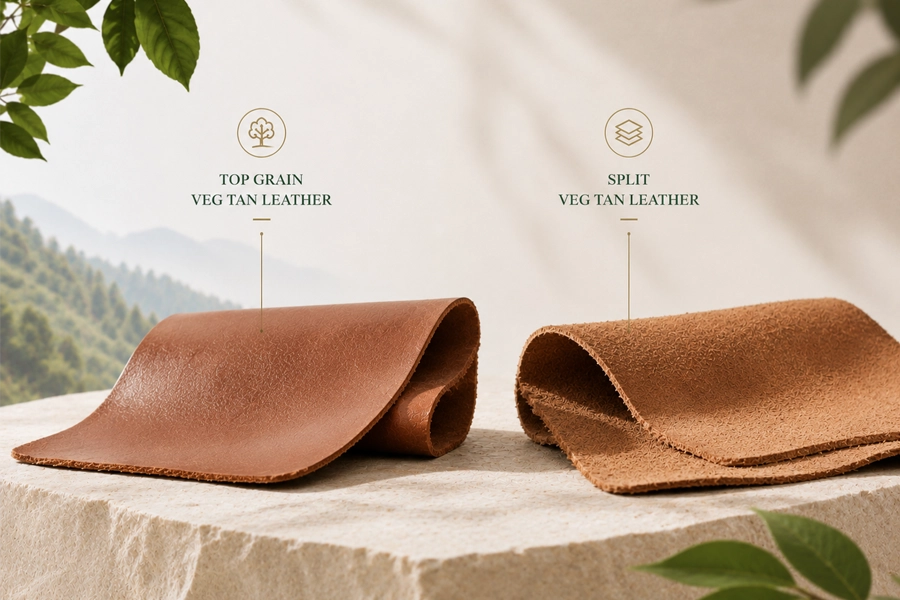
| Source Layer | Outermost hide layer with natural grain and upper reticular fibers | Lower hide layer with no natural grain structure |
| Fiber Density | Tight and neat fibers with strong tensile strength | Loose and messy fibers with poor toughness |
| Natural Features | Retains original pores, grain and natural growth marks | No natural texture; all surface patterns are man-made |
| Material Utilization | 30%-40%, limited by natural hide imperfections | 60%-70%, easy to cover surface flaws |
| Raw Material Cost | 2-3 times higher than split leather | Low cost, suitable for mass production |
Check More About Top Grain Leather vs Split Leather
Importantly, no "split top grain leather" exists in real leather industry.
Terms like microfiber or regenerated top grain are just marketing tricks.
Only leather with original natural grain can be called true top grain leather.
Manufacturing Process Gap That Decides Quality
Raw materials set the quality limit, while craftsmanship widens the gap.
Top grain and split leather adopt totally different production processes.
1. Tanning Process Differences
Top grain leather uses full vegetable tanning with super long processing time.
It goes through dozens of pre-treatment steps before formal tanning.
Manufacturers strictly control temperature and pH for even tannin penetration.
Standard top grain veg tan takes over 60 days to finish tanning.
Premium Italian veg tan leather even needs up to 90 days of tanning.
Split leather uses semi-vegetable tanning for faster and cheaper production.
Its loose fibers cannot withstand long full veg tanning and will break easily.
Synthetic agents speed up curing, shortening the process to 7-15 days.
This cuts costs greatly but reduces leather stability and durability.
2. Surface Finishing Differences
Surface treatment is the easiest way to tell the two leathers apart.
Top grain leather only gets simple buffing, waxing and oiling treatment.
It fully preserves natural pores and original leather grain texture.
With use, it absorbs skin oil and forms unique warm patina gradually.
Split leather has no natural grain and needs artificial surface covering.
Factories laminate PVC or PU film and stamp fake grain patterns on it.
The fake layer covers flaws but blocks air permeability completely.
The film also cracks and peels off after months of daily use.
3. Final Product Processing
Top grain belts adopt one-piece cutting with no spliced segments.
Edges are polished and waxed repeatedly for a smooth round touch.
Hardware parts use brass or stainless steel for firm and durable fixation.
Split belts often use multi-piece splicing to control production costs.
Edges are simply painted and tend to chip off in short time.
Low-cost zinc alloy hardware rusts and deforms easily with use.
Performance Comparison: Durability & User Experience
Process and material differences lead to obvious performance gaps.
These gaps directly affect customer experience and product repurchase rate.
1. Service Life and Durability
Top grain belts resist repeated bending and stretching without damage.
They stay soft and sturdy, with a 5-10 year normal service life.
Split leather belts bend easily and crack at buckle hole positions.
Surface film peels off in 3-6 months, with a 2-year maximum lifespan.
2. Hand Feel and Breathability
Top grain belts feel thick, warm and textured to the touch.
Natural pores ensure great breathability even in hot summer days.
Split belts feel stiff and thin with an obvious plastic touch.
The covered film causes poor ventilation and easy skin sweating.
3. Patina Aging Effect (Core Selling Point)
Patina aging is the most attractive feature of veg tan leather products.
Only genuine top grain leather can form natural and unique patina.
It absorbs human oil and moisture to darken and gloss over time.
Each belt forms exclusive traces matching the user’s usage habits.
Split leather’s outer film isolates all contact with outside air.
It never ages beautifully, only fades and peels with long use.
4. Environmental and Safety Performance
Top grain veg tan leather has no chemical residue or heavy metals.
It is skin-friendly, biodegradable and safe for all user groups.
Split leather uses many synthetic additives and plastic film materials.
Long-term wear may irritate skin and cause environmental waste.
Commercial Value & Suitable Business Scenarios
Neither leather type is absolutely better. It depends on your market positioning.
You can choose reasonably based on your target customers and profit goals.
Top Grain Veg Tan Belt Business Value
It targets mid-to-high-end markets, workwear and customized brands.
Core customers are quality-focused consumers and corporate gift buyers.
Its gross profit margin ranges from 50% to 80% for regular products.
Custom premium belts can achieve over 100% profit margins easily.
It upgrades brand image and builds stable customer loyalty and also meets global green trends for convenient international cooperation.
It fits cross-border e-commerce, high-end gifts and premium workwear.
Split Veg Tan Belt Business Value
It focuses on mass market, fast fashion and promotional gift scenarios.
It serves price-sensitive clients and short-term activity gift demands.
The gross margin is 20% to 40%, relying on large sales volume to profit.
Low cost supports large-scale stocking and fast market response.
It is ideal for fast fashion accessories and corporate event giveaways.
B2B Sourcing Guide: 6 Ways to Identify True Top Grain Leather
Many suppliers disguise split leather as top grain for higher profits.
You can use these simple methods to verify product authenticity fast.
First, check surface grain: top grain has irregular natural textures.
Split leather shows uniform, repeated fake patterns with no real pores.
Second, touch the surface: top grain is warm and thick with texture.
Split leather feels stiff and thin with obvious plastic texture.
Third, observe the cross-section for fiber structure differences.
Top grain has tight uniform fibers; split has loose fibers plus outer film.
Fourth, do a water drop test on the leather surface.
Top grain absorbs water quickly; split leather repels water droplets.
Fifth, bend the leather to check recovery performance.
Top grain forms soft wrinkles and recovers slowly after release.
Split leather leaves permanent creases and may crack after bending.
Sixth, ask suppliers for official leather composition test reports.
Qualified reports must clearly mark genuine top grain veg tan leather.
Final Summary
Global consumers now prioritize product quality and environmental protection.
The veg tan leather belt market keeps growing steadily year by year.
For long-term brand development, top grain leather is the best choice.
It brings differentiated advantages and stable customer reputation.
For cost-effective mass market layout, split leather is a practical option.
Always disclose real material information to avoid brand credit risks.
The best material is the one that matches your business positioning.
Contact reliable belt manufacturers for professional sourcing support and product solutions.
Frequently Asked Questions
Q1: Can split vegetable tanned leather belts form patina?
No.
Split leather is covered with PVC or PU film, which isolates contact with air and human skin. It cannot absorb grease and moisture, so it will never produce natural patina, only aging and peeling damage.
Q2: Is vegetable tanned leather eco-friendly for European and US markets?
Yes.
Genuine full vegetable-tanned leather uses only natural plant tannins, contains no heavy metals or harmful chemicals. It fully complies with EU REACH and California Proposition 65 standards and is completely biodegradable.
Q3: Which leather belt is more suitable for mid-to-high-end brand positioning?
Full vegetable-tanned top grain leather belts are the best choice. They have unique aging value, stable quality and high brand recognition, which are widely used in European and American mid-end, high-end and light luxury accessory markets.
Q4: What scenarios are split veg tan leather belts suitable for?
They are ideal for fast fashion accessories, corporate promotional gifts, activity giveaways and low-end workwear matching. They feature low cost and fast production for large-volume market sales.
Q5: What customization services can you provide for veg tan leather belts?
We support embossed, engraved and printed logo customization, personalized color matching, pattern embossing, text engraving and vintage surface finishing. All customization is available for both top grain and split leather belts.
Q6: Do you support sample orders before bulk procurement?
Yes. We provide customized sample services for B2B buyers. After sample confirmation and approval, we will start mass production to ensure the products fully meet your market standards.
Q7: What shipping terms do you support?
We support mainstream international shipping terms such as EXW, FOB, CIF and DDP. We can match flexible shipping solutions according to your procurement needs.
Q8: What is your mass production lead time?
The lead time depends on product craftsmanship and order quantity. Conventional bulk orders take 7 to 15 working days, and customized top grain leather products take 15 to 25 working days.
Q9: Do you support long-term stable customized cooperation?
Yes.
We have long-term OEM and ODM cooperation experience with European and American brands. We can provide exclusive customized products, stable supply capacity and professional after-sales service for long-term partners.