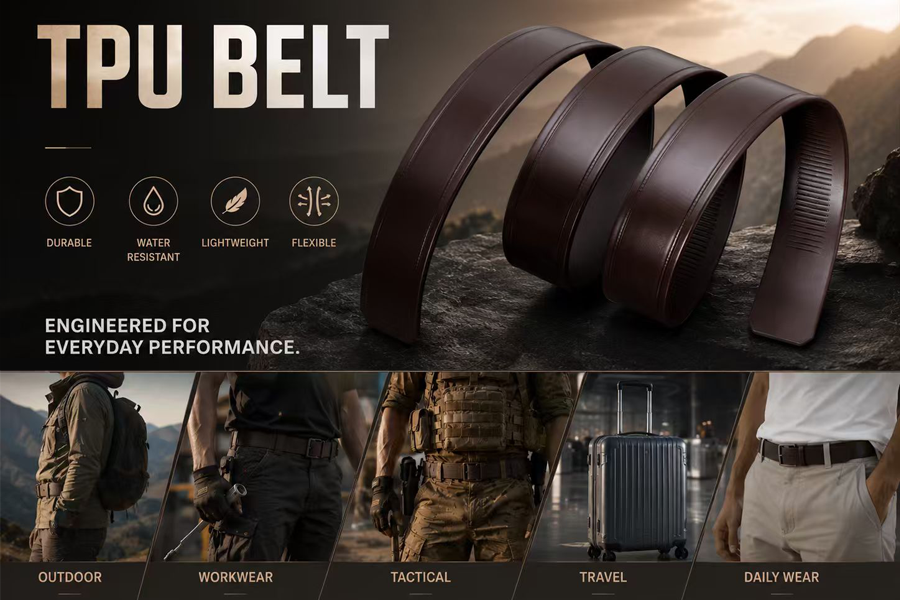
What is a TPU Belt
TPU belts is a durable functional belt made of Thermoplastic Polyurethane (TPU). It is a popular upgraded belt material widely used in European and American B2B markets. TPU belts replace traditional leather, PVC, rubber and regular fabric webbing belts. They combine the stretch of rubber, the toughness of hard plastic and stable eco-friendly performance.
In contrast, cheap coated belts may peel, stick, fade, or break after long shipping and storage. Industrial-grade TPU belts, however, remain stable under high heat, high humidity, strong sunlight, and frequent friction. As a result, they are a reliable choice for bulk purchasing by workwear brands, tactical gear suppliers, outdoor goods distributors, and clothing manufacturers in Europe and North America.
For commercial mass production, TPU belts are divided into two standard types to fit different budgets and uses:
1. Solid one-piece TPU belt:
Made of pure TPU material in one single molded piece. It offers maximum toughness, no layer separation and long service life, ideal for high-end tactical and heavy-duty industrial use.
2. Webbing-based TPU coated belt:
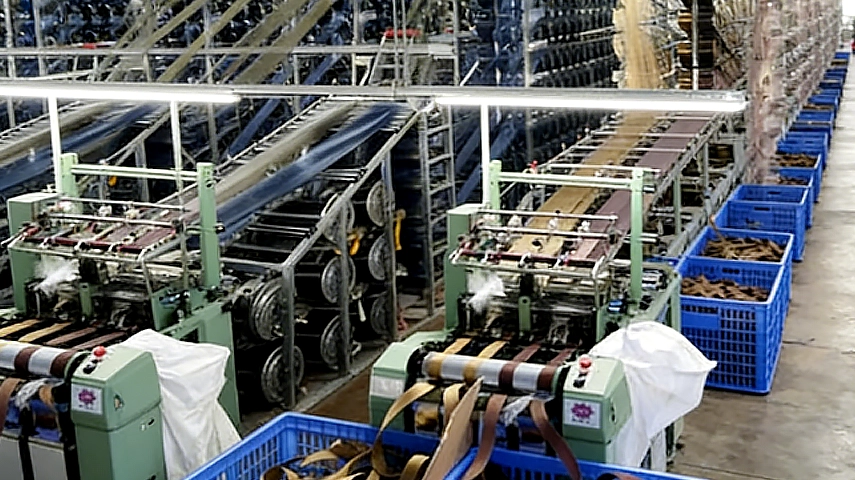
This is the mainstream composite structure for commercial TPU belts, occupying most bulk B2B orders. A seamless, compact TPU outer layer fully covers the 100% high-strength polyester woven fabric inner core.The fabric core and TPU coating have completely divided core functions, forming a dual-layer complementary system. The internal polyester woven fabric is the main load-bearing body, providing ultra-high tensile strength, anti-stretch performance and permanent shape stability. It solves the fatal defect of pure plastic belts that easily elongate, loosen and deform after long pulling.
The outer TPU layer acts as a full protective skin, delivering waterproof, oil-proof, scratch-resistant and anti-aging properties. Compared with solid pure TPU belts, this professional composite structure avoids excessive hardness and high material costs. At the same time, it also overcomes the common weaknesses of ordinary bare webbing belts, such as water absorption, dirt buildup, and poor wear resistance. As a result, it offers a cost-effective and market-friendly solution for mid-to-high-end workwear, outdoor, tactical, and everyday commercial applications.
Both types meet EU REACH, RoHS and US CPSIA safety rules, and support long-term bulk orders as well as OEM and ODM custom requests.
TPU Belt Material Structure & Key Properties
TPU is a special elastic polymer material. Its stable performance comes from two alternating molecular structures: soft segments and hard segments. The balanced ratio of these two parts makes TPU belts more flexible, harder to break, more wear-resistant and longer-lasting than PVC and natural rubber belts.
Soft Segments (Polyester / Polyether):
This part gives the belt softness and elasticity. It allows the belt to bend freely and bounce back to its original shape. It stays flexible even at -40°C without turning hard or cracking.
- Polyester TPU: Better wear resistance and pulling strength, suitable for heavy-duty industrial and tactical use.
- Polyether TPU: Better moisture and hydrolysis resistance, great for humid sea shipping and coastal markets.
Hard Segments:
This part provides hardness, structural stability, scratch resistance and heat resistance. It protects the belt from daily friction, pulling and impact, preventing surface damage and breakage.
Unlike low-grade PVC, qualified B2B-grade TPU contains no harmful plasticizers and is less prone to oil leakage, surface powdering, or hydrolysis-related failure. As a result, its dense and stable structure helps reduce common problems found in traditional belts, such as peeling, sticking, chalking, and brittle cracking.
For composite TPU belts, however, the internal polyester woven fabric core plays the most important role in structural support. While ordinary single-layer plastic belts rely mainly on the toughness of the plastic itself, they can gradually stretch or loosen under continuous tension. In contrast, the tightly woven polyester core provides stable longitudinal tensile strength and lateral tear resistance. Therefore, it helps the belt maintain its original length, shape, and stability even after long-term wear or repeated heavy-load pulling.
Together with the fully wrapped TPU protective layer, this structure creates a balanced dual-function design. On the one hand, the inner fabric core provides mechanical strength and dimensional stability. On the other hand, the outer TPU layer protects the belt against moisture, abrasion, environmental exposure, and surface damage. Consequently, the two layers work together to improve both durability and long-term performance.
Complete Production Process (Standard B2B Export Workflow)
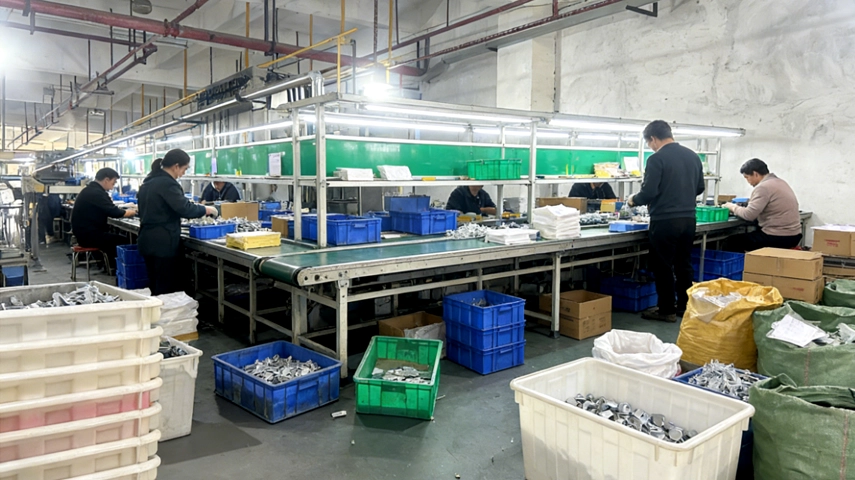
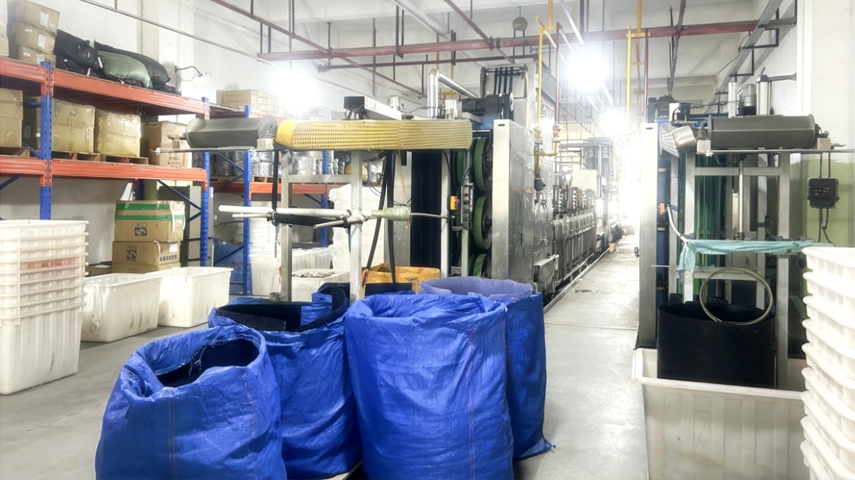
Stable batch quality depends on standardized export-grade production steps. Every process follows strict quality control to avoid delamination, sticking, uneven coating and other common batch defects. The full production flow is listed below:
1. Raw Material Selection & Mixing
We only use export-certified pure TPU pellets and high-strength polyester webbing, while carefully checking all material test reports, strength data, and environmental indicators. Recycled materials and low-quality fillers are strictly prohibited. Based on the required hardness and performance standards, we then select and match the appropriate raw materials to ensure consistent quality across large orders.
2. High-temperature Melting & Extrusion
Industrial machines melt qualified TPU pellets evenly at a stable temperature. Precision molds then extrude the molten TPU into uniform films or solid strips. Throughout the process, operators carefully control temperature and extrusion speed to prevent material damage and uneven thickness.
3. High-pressure Lamination & Molding
For coated TPU belts, the polyester webbing is first cleaned and polished to remove oil, dust, and other surface contaminants, thereby improving bonding strength. Next, the TPU film and webbing are tightly laminated in a single process. In contrast, solid TPU belts are integrally molded without splicing or secondary bonding. As a result, there is no risk of interlayer separation.
4. Constant-temperature Curing & Drying (Core Process)
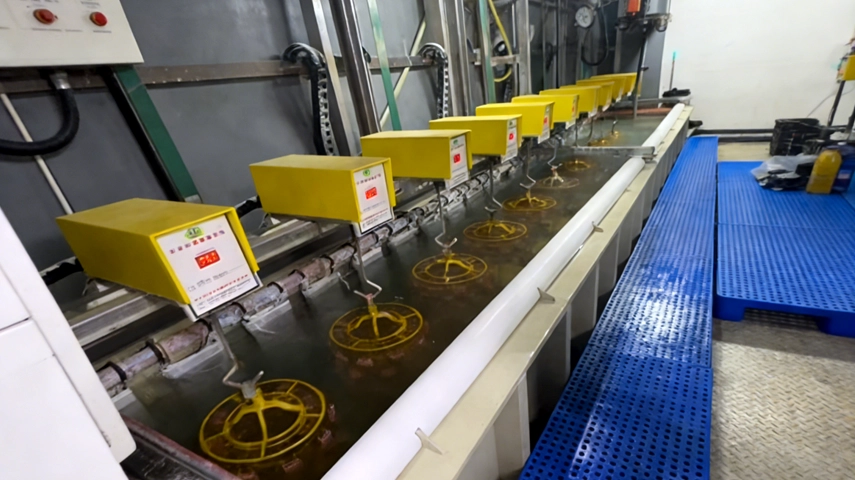
This is the most important step to prevent peeling and sticking. Freshly molded belts go through staged constant-temperature drying and aging treatment. All residual solvent inside the material fully evaporates, and the TPU molecular structure becomes completely cured. This avoids “false dry” quality problems and ensures belts will not stick or peel during high-temperature sea shipping and long stacking storage.
5. Precision Cutting & Shaping
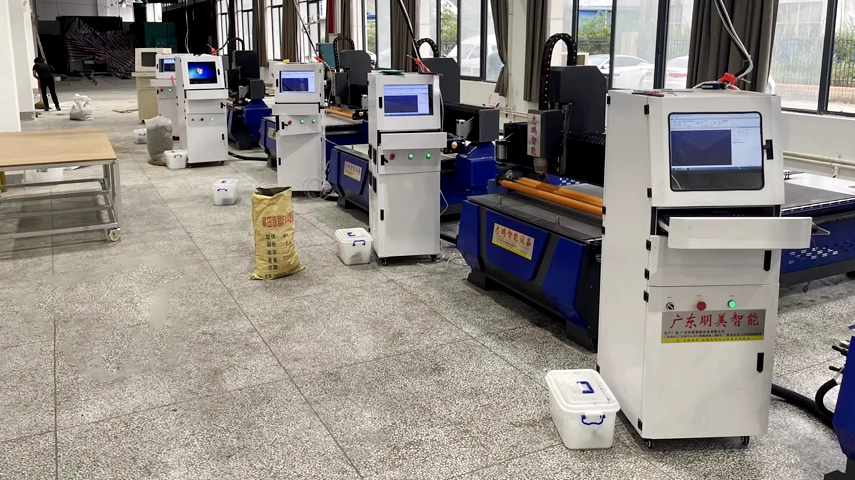
After full curing, belts are cut to fixed sizes by automatic precision machines with smooth, burr-free edges. We also provide edge wrapping, hole punching, groove cutting and surface texture finishing (matte, glossy, frosted) based on customer needs.
6. Surface Treatment & Custom Printing
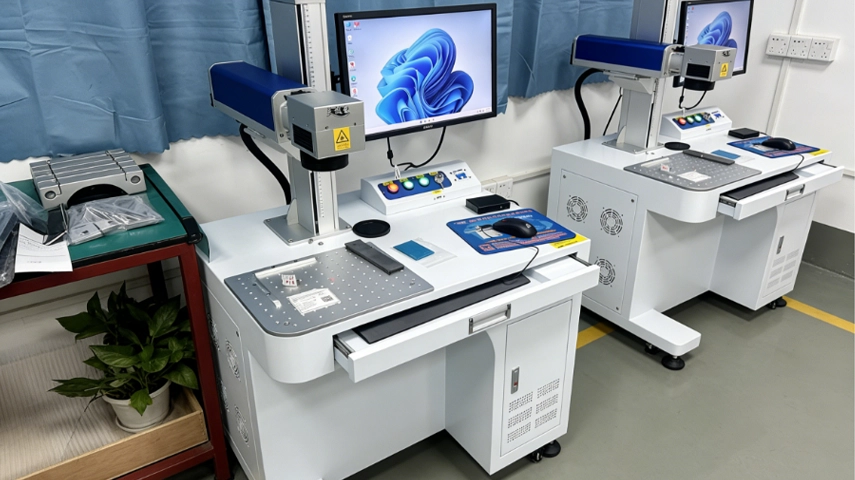
All belts receive anti-yellowing and anti-UV treatment to improve outdoor aging resistance. We support custom logo processing, including screen printing, heat transfer printing and embossing for brand customization.
7. Batch Inspection & Aging Simulation Test
We fully check each batch’s thickness, hardness, tensile strength and appearance. Random samples are tested with high-temperature stacking, low-temperature bending and hydrolysis aging tests to simulate real sea shipping and warehouse storage conditions, ensuring stable mass quality.
8. Dust-proof Packaging & Shipping
Qualified belts are separated with isolation paper one by one to avoid friction and adhesion. We use moisture-proof and dust-proof packaging suitable for long-distance ocean transport. Final inspection is completed before bulk delivery.
Core Advantages for B2B Buyers
1. Excellent Wear Resistance
Industrial TPU is 3–5 times more wear-resistant than ordinary rubber and 8–10 times stronger than PVC. It resists long-term friction, pulling and twisting in industrial and outdoor scenarios. It greatly reduces product replacement frequency and after-sales costs for bulk buyers.
2. Waterproof, Oil-proof & Easy to Clean
TPU’s tight molecular structure does not absorb water, sweat or industrial oil. It works well in rainy, sweaty and oily working environments. The surface can be cleaned easily with water or cloth. It never gets moldy, corroded or smelly, perfect for frequent commercial use.
3. Strong Weather & Anti-aging Performance
With professional anti-UV formula, TPU belts resist sunlight damage and color fading. They keep stable performance in extreme temperatures from -40°C to 120°C. They will not harden, crack or deform, adapting to complex weather conditions in European and American regions.
4. No Peeling & No Stacking Adhesion
Thanks to full curing technology and high-pressure lamination, the bonding force between layers is extremely strong. Even under high temperature and high humidity during sea shipping and long-term stacking, the belts will not delaminate, peel or stick together. Zero batch quality complaints.
5. Eco-friendly & Fully Compliant
Our TPU belts contain no phthalates, heavy metals or harmful additives. They fully meet EU REACH, RoHS and US import standards. The material is thermoplastic and recyclable, matching European and American brand sustainability requirements.
6. High Customization & Stable Batch Quality
We can customize belt hardness, thickness, color, surface texture, size and brand logo. The whole production process is automated with fixed parameters, ensuring stable quality for repeated large orders and long-term OEM/ODM cooperation.
TPU Belt vs. Traditional Belt Materials
VS Leather Belts
TPU belts offer better cost performance for bulk purchase. They need no special maintenance, are fully waterproof and mold-proof, and do not crack, peel or fade like real leather. They are not affected by high heat and humidity during shipping and storage, making them more suitable for large-scale wholesale.
VS PVC Belts
Traditional PVC belts contain large amounts of plasticizers. After long storage, they easily turn hard, brittle and powdery. Our TPU belts have no plasticizer leakage, better weather resistance and higher environmental compliance, avoiding customs rejection risks in European and American markets.
VS Ordinary Webbing Belts
Pure fabric webbing belts easily get dirty, absorb water and deform. TPU coated belts have a tight protective outer layer that is waterproof, stain-resistant and scratch-resistant. They look neater and more professional with higher commercial value.
B2B Application Scenarios
1. Industrial Workwear & Labor Protection
Widely used for factory work belts, construction safety belts, logistics tool belts and staff uniform matching belts. Durable and low-maintenance for high-intensity working environments.
2. Outdoor & Sports Gear
Suitable for hiking belts, camping belts, outdoor adventure belts and fitness sports belts. Stable performance adapts to changeable outdoor weather.
3. Tactical & Security Equipment
Used for police duty belts, tactical protective belts and training supporting belts. High tensile strength and structural stability meet professional tactical standards.
4. Functional Apparel Brand Matching
Support customized matching belts for outdoor functional clothes, techwear workwear and fashion functional garments for clothing brands.
5. Daily Casual Fashion Accessories
Popular as tech-style casual belts for daily wear. Balances durability and modern design, suitable for mass consumer sales in Europe and America.
Contact reliable belt manufacturers for professional sourcing support and product solutions.
B2B Procurement FAQ (Simple & Clear)
Q1: Why do many cheap belts peel and stick after sea shipping, while yours do not?
A: In contrast, many low-cost belts rely on insufficient drying or incomplete curing processes. As a result, residual solvents may remain inside the material, causing stickiness under high temperature and humidity during ocean shipping and eventually leading to peeling or layer separation. To address this issue, our belts use a staged constant-temperature curing process combined with high-pressure integrated lamination. Therefore, residual stickiness is significantly reduced, which helps prevent belts from sticking together or delaminating during shipping and stacking.
Q2: What is the difference between polyester TPU and polyether TPU? How to choose?
A: In comparison, polyester-based TPU offers better wear resistance and tensile strength, making it well suited for industrial, tactical, and other heavy-duty applications. On the other hand, polyether-based TPU provides better moisture resistance and low-temperature performance, making it a better choice for humid coastal regions and cold-climate markets. Therefore, we can recommend the most suitable TPU material based on your target market, application requirements, and product positioning.
Q3: Can your TPU belts pass EU REACH and RoHS tests?
A: Yes. All raw materials are export-grade eco-friendly materials with no harmful substances. We can provide complete test reports and certification documents to support your customs clearance and brand quality inspection.
Q4: Do you support custom sizes, colors and logos for bulk orders?
A: Yes. We provide full one-stop customization: size, thickness, hardness, color, matte/glossy surface, screen printing, heat transfer logo and edge finishing. All support OEM and ODM brand orders.
Q5: What is your batch quality stability and after-sales policy?
A: Before delivery, every batch undergoes strict aging simulation and high-temperature stacking tests to verify product stability. As a result, mass production quality remains stable and consistent. In addition, for orders produced with our standard materials and manufacturing processes, we provide reliable after-sales quality assurance to help reduce the risk of batch defects.